BREAKING: Largest Real-World Study of Ivermectin + Mebendazole in Cancer Patients Shows 84.4% Clinical Benefit — Nearly HALF Report Cancer Disappearance or Tumor Regression
🚨🚨BREAKING: The Pharmaceutical Industrial Complex is going to MELT DOWN HARD…Children’s Health Defense just EXPOSED THE SCAM…Ivermectin is CRUSHING cancer like chemotherapy NEVER could. Nearly 200 patients. Multiple cancer types.84% POSITIVE OUTCOME. pic.twitter.com/3g2jIuDvrh
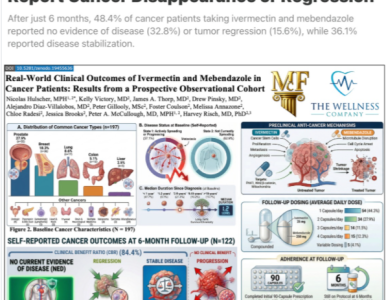
After just 6 months, 48.4% of cancer patients taking ivermectin and mebendazole reported NO EVIDENCE OF DISEASE (32.8%) or tumor regression (15.6%), while 36.1% reported disease stabilization⬇️
We have completed the largest real-world human analysis to date evaluating ivermectin and mebendazole in cancer patients—and the results represent one of the most compelling clinical signals ever documented for repurposed anti-parasitic therapies in oncology.
The groundbreaking analysis was made possible through a unique collaboration between The Wellness Company, the McCullough Foundation, and the Chairman of the President’s Cancer Panel (Dr. Harvey Risch)—uniting real-world clinical data, frontline medical experience, and high-level epidemiologic expertise to deliver urgently needed insights in oncology.
This was a real-world prospective clinical program evaluation of 197 cancer patients, with 122 completing a follow-up survey at about six months (61.9% response rate).
Cancer patients were prescribed compounded ivermectin–mebendazole, with each capsule containing 25 mg ivermectin and 250 mg mebendazole—most commonly taken at 1–2 capsules per day.
The cohort represented a clinically relevant population, including a wide variety cancer types, with 37.1% of patients reporting actively progressing disease at baseline and many having already undergone chemotherapy, radiation, and surgery.
At six months, 84.4% of cancer patients reported clinical benefit (Clinical Benefit Ratio: 84.4% [95% CI: 77.0–89.8%]):

32.8% reported no evidence of disease (95% CI: 25.1–41.5%)
15.6% reported tumor regression (95% CI: 10.2–23.0%)
36.1% reported stable disease (95% CI: 28.1–44.9%)
Treatment adherence was high, with 86.9% completing the full protocol and 66.4% remaining on therapy at six months.
The regimen was well tolerated, with 25.4% reporting side effects, primarily mild and gastrointestinal.
This is NOT the end. We will continue advancing this work with larger datasets.

10 CANCER PREVENTION TIPS
1. Strong gut health
2. pH levels no lower than 7.25
3. Good oxygen in your bloodstream and tissues.
4. Keto diet, low carb and sugar intake
5. Minimum 10,000 IU vitamin D3 + K2 & Magnesium
6. Iodine & Selenium (for women)
7. Parasite cleanse every six months
8. Eat in an eight hour window or less each day
9. Do a 3-day water fast every other month. Make one a 5-day fast
10. Eat Whole Foods 80% of the time
(STUDY LINK) Real-World Clinical Outcomes of Ivermectin and Mebendazole in Cancer Patients: Results from a Prospective Observational Cohort
Abstract Background: Drug repurposing offers a pathway to identify accessible, low-toxicity cancer therapies. Ivermectin and mebendazole have demonstrated multi-target anti-cancer activity in preclinical models, including the inhibition of cancer cell proliferation and the targeting of cancer stem cells. This paper evaluates real-world patient-reported outcomes, safety, and adherence in a cohort of cancer patients utilizing this combination protocol.
Source de l’information
No Description